Your handy guide for troubleshooting Kubernetes clusters with a list of commonly used kubectl commands to display one or many resources when running commands against clusters. Click to copy to clipboard easily, or download the PDF cheatsheet as a useful reference.
Cluster
kubectl versionkubectl cluster-infokubectl config viewkubectl config get-contextskubectl config current-contextkubectl config use-context [cluster_context_name]kubectl api-versionskubectl api-resourcesLogs
kubectl logs [pod_name] -n [namespace]kubectl logs -f [pod_name] -n [namespace]kubectl logs -f [pod_name] -c [container_name] -n [namespace]kubectl logs --tail=20 [pod_name] -n [namespace]kubectl logs --since=1h [pod_name] -n [namespace]kubectl logs --previous [pod_name] -n [namespace]kubectl logs -l name=[label_name] -n [namespace]Resources
kubectl top nodekubectl top podkubectl cordon node [node_name]kubectl uncordon node [node_name]kubectl drain node [node_name]Events
kubectl get eventskubectl get events --field-selector type=Warning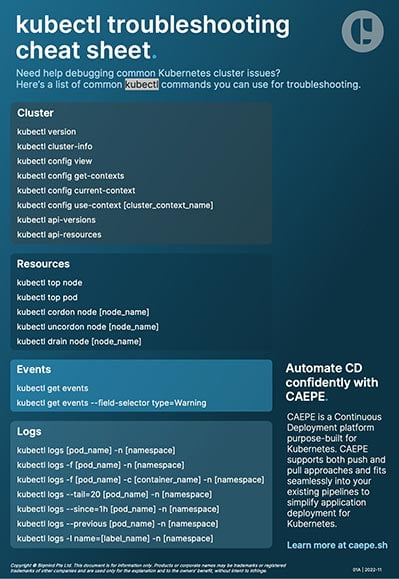
Download the PDF version of this kubectl cheat sheet

CAEPE Continuous Deployment
Manage workloads on Kubernetes anywhere robustly and securely.
- Shores up security by simplifying deployment anywhere, supporting managed services, native Kubernetes, self-hosted, edge and secure airgapped deployment targets.
- Supports GitOps and provides guided, UI-driven workflows for all major progressive delivery strategies.
- Has RBAC built-in, providing inherent enterprise access control for who can deploy.
- Supports extended testing capabilities enabling your team to run different tests quickly and easily.